
Checking Criminal History in Williamson
Start with the office that made or filed the record. Williamson City Hall holds city administrative material and the municipal ordinance docket. The Pike County Sheriff is the documented law-enforcement route for Williamson incidents, arrests, jail bookings, and warrant-service questions. The Pike Clerk of Superior Court holds filed felony and misdemeanor cases. GCIC holds a different, identity-linked state history.
- Ask City Hall whether the matter is a Williamson ordinance or municipal court file.
- For an incident or arrest, contact Pike County Sheriff and identify the date, place, and report or booking number if known.
- Call the Williamson clerk for the municipal docket because the city publishes no online case search.
- Check the Pike clerk for an accusation, indictment, warrant filed in a case, disposition, or certified copy.
- Use an official GCIC route for a statewide history or Georgia Felon Search for its limited felony-conviction product.
These channels answer different questions. A sheriff report describes the event, a booking record describes custody, and a court file shows what prosecutors filed and how a judge resolved it.
Sheriff, Not a Williamson Police Department
The official Williamson service list does not identify an operating police department. Pike E-911 names the sheriff, Zebulon Police, and Molena Police, but not Williamson Police. That is stronger routing evidence than generic language in the municipal code that permits a police officer, bailiff, or special officer to serve a court function. Such language does not establish that Williamson currently runs a department.
For Williamson criminal records tied to an incident, arrest, traffic response, or warrant service, begin with Pike County Sheriff at 89 Jackson Street in Zebulon. The verified nonemergency number is 770-567-8431. A written request can be delivered by mail, fax, email through the official sheriff page, or at the counter after confirming the custodian. Ask for an existing report rather than asking staff to create a new criminal-history summary.
Myth: every incorporated city keeps its own police reports. Fact: Williamson city records and county law-enforcement records have different custodians.
Williamson Police Department Records
Because no current Williamson police department was verified, there is no city police records unit, report portal, mobile app, blotter, fee schedule, or police-counter hour to publish. A requester should not send an incident request to a guessed department or rely on a similarly named agency from another jurisdiction. Call City Hall only when agency ownership is uncertain, then route the request to Pike County Sheriff if the city confirms county service.
The sheriff can hold an incident or arrest narrative created by its deputies and the separate booking file made when someone enters Pike County Jail. Pike E-911 may hold dispatch or CAD material on another track. The sheriff line is 770-567-8431, while verified nonemergency dispatch is 770-567-7296. Neither office publishes a Williamson-specific request form, fee, retention schedule, or release rule. Narrow dates and locations help the custodian find the actual record.
Williamson Records at the Midland Street Counter
Williamson City Hall is at 71 Midland Street, Williamson, GA 30292. Clerk Pamela Schoentag can be reached at 770-227-8380 or clerk@cityofwilliamsonga.org. The city publishes weekday hours of 8:00 a.m. to 4:00 p.m., with a noon to 1:00 p.m. lunch closure. Mail goes to P.O. Box 9, Williamson, GA 30292, and the fax number is 770-227-8623.
This counter is the practical route for a Williamson municipal court record, ordinance material, and city administrative files. The city forms page links a Public Records Request PDF, but its fields were not available to text inspection during research. A requester can still identify the desired existing file, date range, case or citation number, subject name when necessary, preferred delivery method, and a cost ceiling. Confirm any required form field with the clerk rather than assuming it.
The official Williamson city site shows the civic setting for this city-level records route.
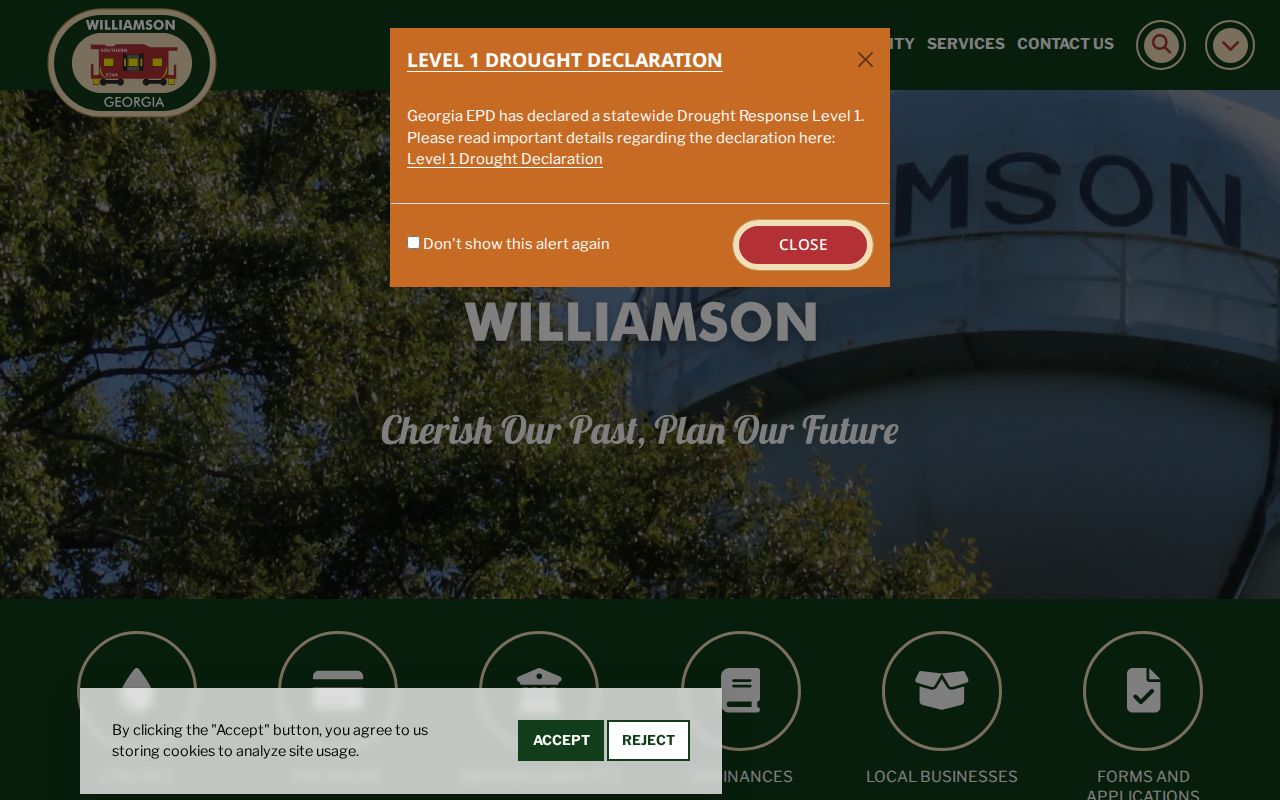
The image reinforces why Midland Street, not an invented police portal, is the local starting point for Williamson administrative and court questions.
Williamson Arrests and Bookings
A Williamson arrest can create several records at once. The responding sheriff's deputy creates an incident or arrest report. If the person is taken into custody, Pike County Jail creates booking, identity, charge-at-intake, bond, and custody information. Fingerprints may create an arrest cycle at the Georgia Crime Information Center. A prosecutor later decides what charge, if any, to file in court.
Pike County does not publish a live person-search jail roster or daily booking blotter. The sheriff page publishes quarterly jail reports, but those are operational summaries and cannot prove whether a named person is now confined. Call 770-567-8431 to ask what identifying information staff need, whether a booking number is available, and whether written confirmation can be provided. Staff may limit phone disclosure.
For more depth on county custody channels, the contextual Pike County arrest lookup explains the sheriff, E-911, court, GSP, and state fallbacks.
Tracing a Williamson Sheriff Arrest
The Williamson record trail is easiest to follow in time order. First, identify whether Pike Sheriff or another agency responded in Williamson. Second, ask the jail about current custody and a booking number. Third, request the arresting agency's Williamson narrative. Fourth, check the Pike Clerk Criminal Division after charges are filed. Finally, compare a certified disposition with one's own GCIC history if a state record looks incomplete.
Those Williamson stages may not match word for word. Booking charges reflect intake, while an accusation or indictment reflects the prosecutor's filing choice. A dismissal, plea, verdict, or sentence belongs in the court file. If a Williamson disposition is absent from GCIC, the submitting agency must document a correction; GCIC cannot change it merely because a caller describes an error. Keeping the Williamson report number, booking number, Offender Tracking Number, and court case number makes follow-up far more precise.
Municipal Court Records in Williamson
Williamson's municipal code establishes a court for city-law and ordinance violations with subpoena and sentencing authority. The published schedule calls for sessions at City Hall on the first Thursday of each month at 9:00 a.m., if needed. The judge may use the second Thursday, skip a holiday month, or add a session. Confirm the actual date before relying on the normal schedule.
| Court Name | Williamson Municipal Court at City Hall, 71 Midland Street |
|---|---|
| Case Types Heard | City-law and ordinance violations within municipal jurisdiction |
| Case Lookup Channel | Call or visit the city clerk, or submit a Georgia Open Records Act request; no online docket was found |
| What the File May Show | Citation or charge, scheduled session, plea, court action, sentence, subpoena, and related city filings when present |
| Copies & Fees | Ask the clerk for current search, copy, certification, and delivery charges before ordering |
The code mentions a failure-to-appear fee set by council and a standard fine or cash-bond schedule. The research did not establish their current amounts, so requesters should not rely on an old figure.
Williamson's Budget Line Is Not a Records Fee
The Williamson FY2025 budget projects $30 under an “Admin Open Records Requests” revenue line. That accounting entry is not proof that every request costs $30. It does not identify a per-page charge, staff rate, certification price, or flat request fee. Treating it as a fee schedule could cause a requester to authorize the wrong amount or assume that inspection requires payment.
Georgia law permits reasonable search, retrieval, and redaction charges tied to the lowest-paid qualified employee, with the first quarter-hour generally free, plus lawful copying charges. Actual cost still depends on the request and the records. Ask Pamela Schoentag for an estimate, set a written ceiling, and say whether inspection, electronic copies, paper copies, or certification is needed. A narrow request for a known case is easier to price than a broad request for all records about a person.
Where Williamson Records Go
Williamson criminal records move according to agency ownership, not city boundaries alone. A sheriff response stays with Pike Sheriff at the report stage. Booking information stays with the jail. A municipal ordinance case remains with the Williamson clerk. A felony or misdemeanor prosecuted in Pike Superior Court becomes part of the Pike clerk's criminal file. Fingerprinted arrests and reported dispositions can become part of GCIC's state history.
Record flow: Pike County Sheriff serving Williamson › Pike County Courts › Georgia Bureau of Investigation, Georgia Crime Information Center
For a very recent event, start close to the event. For the filed charge and outcome, use the correct court. Georgia Felon Search is only a paid in-state felony-conviction product and omits misdemeanors, nonconvictions, juvenile felonies, restricted cycles, and completed First Offender matters. It cannot replace the Williamson municipal file or Pike case file.
Williamson Court Dates Can Shift
The first-Thursday rule is a baseline, not a promise that court meets every month. A second-Thursday substitution, holiday omission, added session, or no-needed-session decision can change when a particular Williamson court record is created. Calling 770-227-8380 before travel is the sound way to confirm whether court will sit and whether the clerk can provide a docket entry or copy.
The same caution applies to online absence. Williamson publishes no municipal docket search. A missing web result therefore says nothing about whether a city case exists. It only shows that the city does not expose that channel. The Pike clerk's advertised civil/criminal search was also a placeholder during inspection, and a county search is not exhaustive for Williamson ordinance matters. Direct clerk contact is part of the normal access chain, not merely a last resort.
Williamson Records and Its Railroad Past
Official planning history links Williamson's name to the Williamson family, which gave land for the railroad. Peaches and cotton also shaped the city's development. That history, reflected in the motto “Cherish our past, plan our future,” helps explain why city minutes, ordinances, planning files, and municipal records can matter alongside current criminal case material.
Historical or genealogy research should begin with a defined record series and date range rather than a modern criminal-history request. City Hall can identify whether it holds older municipal minutes or ordinance records, while older court material may belong with a court clerk or archive. The Williamson Library, Education and Arts Facility and the Benson Hilley walking trail are civic anchors, but neither should be assumed to hold official case files. Custody follows the creating office.
Williamson Public Records Request Choices
A written Williamson request is useful when no online docket exists. Name the city clerk as custodian for a municipal file, or Pike Sheriff for a sheriff-created incident or booking record. Describe the existing document, give a narrow time span, and include a citation, case, report, or booking number when available. Ask for segregable public portions if part of a file is exempt.
The Georgia Attorney General says requests may be oral or written, but writing best preserves scope and timing and is required for enforcement. An agency generally responds within three business days when records are available. If production cannot occur then, the response may provide a timetable and estimate. That deadline is not a promise that a large file set will be delivered in three days, and the agency need not create a new summary.
Public Access Rules in Williamson
Public access does not mean every page in a Williamson police or court file must be released. Active-investigation material, juvenile records, protected identity data, sealed files, and information restricted by criminal-history dissemination rules may be withheld or redacted. The custodian should cite the specific exemption. A requester can narrow the demand or ask for the nonexempt parts.
Key Statutes:
Georgia Open Records Act, O.C.G.A. §50-18-70 et seq. - Direct a request to the custodian for an existing record and expect a response or production timetable under the Act.
O.C.G.A. §35-3-34 - Georgia limits dissemination of criminal-history information and defines the public felony-conviction route.
O.C.G.A. §35-3-37 - Georgia provides record-restriction and court-sealing processes for qualifying records.
A public record may still be incomplete or later corrected. Verify a legal outcome with the court order or certified disposition held by the originating office.